Progesterone Unmasked: Separating Natural Protection from Synthetic Risk
Unpacking the evidence on natural progesterone and breast cancer — why it may protect rather than harm breast tissue.

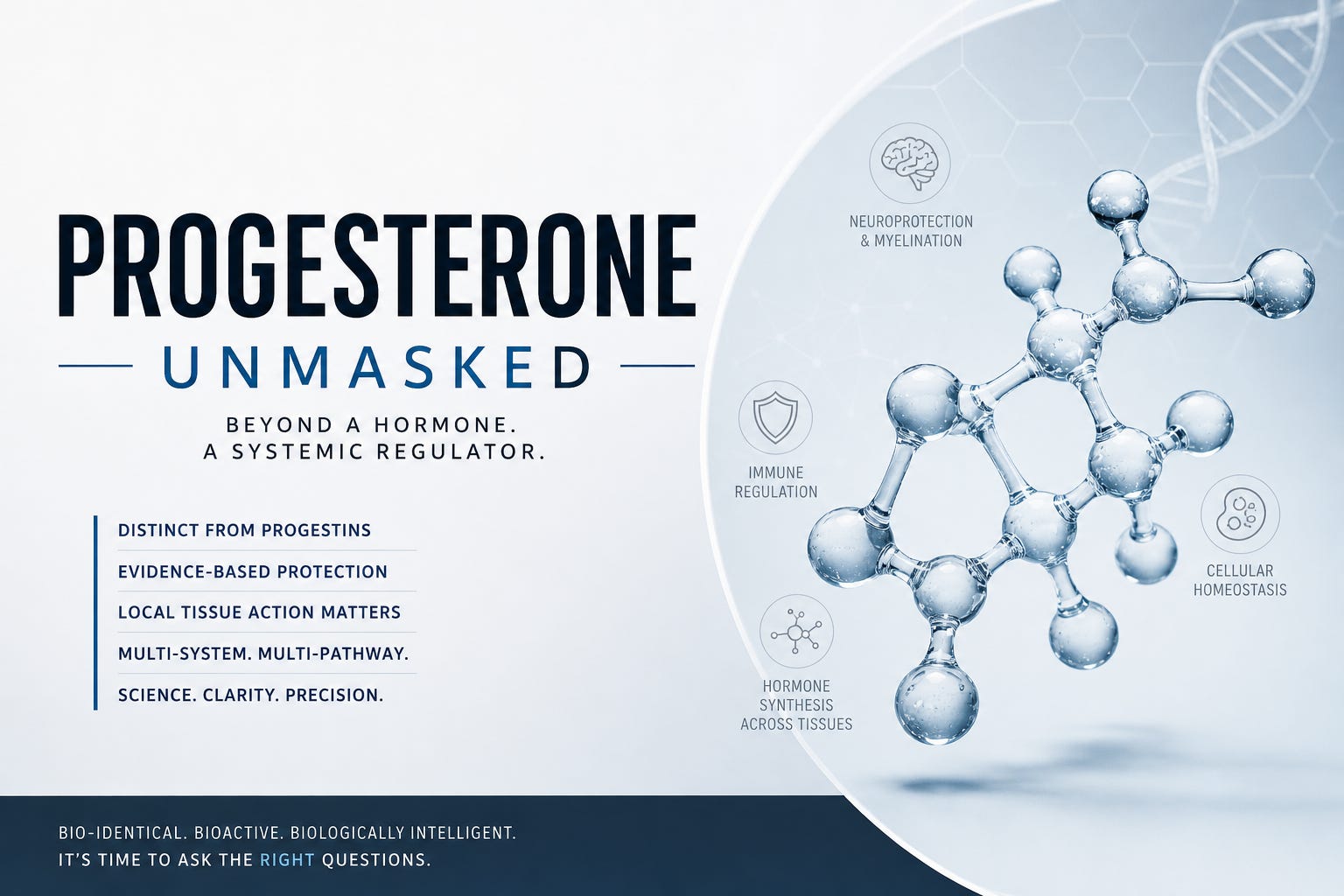
For decades, the word “progesterone” has often been met with caution—if not outright fear—in the context of breast health. This apprehension largely stems from the Women’s Health Initiative (WHI) study that triggered what many call the “decade of fear,” suggesting that combined hormone therapy significantly increased breast cancer risk.
Emerging evidence tells a different story: progesterone has been fundamentally misunderstood because it has been repeatedly conflated with synthetic progestins.
The Critical Distinction: Progesterone vs. Progestins
The source of much clinical confusion lies in a fundamental biochemical error: equating synthetic progestins with natural, bio-identical progesterone.
They are not the same.
Synthetic Progestins (like Medroxyprogesterone acetate or MPA) are chemically altered molecules designed to be patentable. They only need to mimic a few of progesterone’s effects; their other impacts on the body are often unknown or harmful—most notably promoting cell proliferation in breast tissue.
Natural (bio-identical) Progesterone exactly matches the molecule your body produces. It exerts a complex, multi-systemic balancing effect that decreases proliferation and encourages cellular maturation in breast tissue.
A massive French study (the E3N cohort) of 80,000 women confirmed this distinction: estrogen combined with synthetic progestins increased breast cancer risk by 69%, while estrogen combined with natural progesterone showed 0% increased risk—effectively neutralizing the risk seen with estrogen-only therapy.
Beyond Reproduction: A Systemic Regulator
We have historically viewed progesterone strictly as a “female reproductive hormone” synthesized by the ovaries and placenta. Modern science reveals a far broader picture: it is a ubiquitous, multi-system regulatory factor produced and metabolized by at least 14 distinct cell types across the body.
Nervous System: Synthesized by neurons and astrocytes for neuroprotection; it also drives critical myelination in both the central and peripheral nervous systems.
Immune System: Groundbreaking 2025 research shows mast cells produce progesterone specifically to regulate inflammation. It acts as a cellular “shield,” preventing the “histamine dumps” triggered by dominant estrogen. See review on progesterone’s immune-modulating effects
Adrenal glands: Provide a continuous baseline of systemic progesterone independent of reproductive cycles.
Male physiology: In the testes, progesterone is an essential precursor step before conversion into testosterone.
Even experimental models: Pluripotent embryonic-type cells (such as certain teratoma-derived lines) can spontaneously synthesize progesterone.
The “Local Factory” Problem: Why Blood Tests Aren’t Enough
One of the biggest gaps in endocrine oncology is the assumption that serum (blood) hormone levels accurately predict what’s happening in breast tissue. This assumption is frequently wrong.
Breast tissue functions as its own active “hormone factory,” generating high levels of estrogen locally through enzymes such as aromatase and sulfatase. Sulfatase activity inside tumors can be 10× higher than in blood plasma. A woman can have low serum estradiol yet still experience strong local estrogenic drive in her breast tissue. This is exactly why a localized progesterone response is needed to maintain tissue homeostasis.
The Protective Symphony: A Multi-Pronged Strategy
Progesterone doesn’t simply “oppose” estrogen. It orchestrates a sophisticated anti-cancer strategy through interconnected pathways:
Reprogramming the Estrogen Receptor (ER): When progesterone binds its receptor (PR), it physically interacts with the ER. This “reprograms” the ER to stop activating growth genes (like Bcl-2) and instead turn on pro-apoptosis genes (like p53) that tell damaged cells to die.
Taming Pro-Cancer Pathways: It powerfully inhibits inflammatory enzymes like COX-2 and the oncogene HER-2/neu, while blocking aromatase (especially via its protective metabolite 20αDHP), cutting off a key fuel source for cancer cells.
mTOR Suppression: Progesterone directly inhibits the mTOR pathway (the same target as the drug rapamycin). This delivers dual benefits:
Promotes stable Regulatory T-cells (iTregs) that dampen chronic inflammation.
Triggers autophagy—the body’s cellular housekeeping process—leading to either senescence or programmed cell death in damaged cells.
The Complexity of Receptors and Dosing
The Progesterone Receptor exists in two main isoforms: PR-A and PR-B. A tissue labeled “PR-positive” can behave very differently depending on which isoform dominates. Progesterone also triggers rapid non-genomic effects through membrane receptors (mPRs) that synthetic progestins cannot replicate.
Dosing follows a “Hormesis Paradox”: very low doses can sometimes cause transient hyperstimulation, while higher physiologic doses produce membrane stabilization, anti-inflammatory effects, and calm.
Human Evidence: The “Physiologic Brake”
This isn’t just theory. The Chang Presurgical Window Study gave women topical progesterone before breast surgery and found it reduced cell proliferation below placebo levels. When combined with estradiol, progesterone “braked” the proliferative surge that estrogen alone would have caused—directly in living human breast tissue.
This evidence supports the Surgical Timing Hypothesis: surgery performed during the progesterone-rich luteal phase may occur in a more stable tissue environment. Early data from Badwe et al. 1991 and the 2011 intervention trial (single preoperative depot progesterone) showed clinically meaningful benefits, especially in node-positive disease.
A New Paradigm for Women’s Health
The Progesterone Paradox is resolvable. We must shift toward biochemical precision:
Progesterone and synthetic progestins are not interchangeable.
Local tissue biology—not just blood levels—drives outcomes.
Rigorous human tissue evidence positions progesterone as a physiologic brake and tissue stabilizer.
Precision oncology should rely on biomarker-guided investigation rather than blanket dismissal.
The question is no longer whether progesterone belongs in the conversation about breast oncology. The real question is whether we are finally ready to ask the right questions.
For more information, visit thewellnessbydesignproject.com.
This is not medical advice. Hormone decisions should be made with a clinician who stays current on the evolving literature.